Community Housing Development Corporation Expands Access to Clean Mobility 

For many, climate change can feel distant and is often perceived as something unlikely to impact our daily lives or immediate future. Growing evidence makes clear that taking action now is essential to slowing its effects and preserving the health of our environment. Environmental changes are already impacting critical aspects of daily life, from food systems to infrastructure and overall quality of life. Unfortunately, underserved communities bear the greatest burden of these challenges, experiencing disproportionate impacts that deepen existing racial and social inequities. 

Community Housing Development Corporation (CHDC) is working to change that reality. Through the Driving Clean Assistance Program (DCAP), the organization is advancing solutions that are both people-centered and planet-focused. The program is intentionally designed to assist California’s low-income and disadvantaged residents that have historically been left out of clean energy programs by assisting them with purchasing clean air vehicles.  

CHDC partners with credit unions that provide the loans for electric vehicles (EVs), aligning with the organization’s mission to create economic opportunity and stability for underserved communities.  

The EV Process and Its Impact on Underserved Communities 

DCAP is built with accessibility at its core. The process begins with residents checking their eligibility and submitting an application. Approved applicants work with a network of enrolled dealerships to select a qualifying battery electric, plug-in hybrid, or fuel cell vehicle, and the grant is applied directly during purchase. DCAP pairs vehicle grants of up to $12,000 with interest rate caps, while CHDC expands access to credit and provides financial coaching to help combat limited access to affordable capital and predatorylending practices.  

Families that have benefited from the program report resulting in less financial stress allowing remaining funds to be redirected toward savings, homeownership, and building generational wealth. 

“The goal is to meet people where they are and build a pathway to ownership that is genuinely accessible, not just technically available,” Donald Gilmore, Executive Director of CHDC, said. “Environmental justice isn’t just about reducing emissions; it’s about ensuring that the communities who have suffered disproportionate environmental harm are the first to benefit from solutions. Everything we do at CHDC, from affordable housing to clean transportation to community engagement, is designed to make that a reality in the neighborhoods we serve.” 

Since launching in 2024, DCAP has provided EVs to 1,670 participants across California. In December 2025 alone, 394 residents completed their vehicle purchasereflecting significant improvement in processing capacity and overall program volume. 

Shaping a More Equitable Future Through Green Finance 

As a leader in green finance, CHDC drives sustainable efforts through key initiatives like the North Richmond Waste and Recovery Mitigation Fee Joint Expenditure Planning Committee, which directs resources toward cleanup efforts in historically impacted neighborhoods. The organization also hosts an annual Earth Day event and integrates sustainability into its affordable housing developments. Through strategic partnerships with NeighborWorks America affiliates, CHDC is working to close critical gaps and expand its impact across the communities it serves. 

“I hope we see a fundamental shift in who gets to participate in the clean energy transition — not just in California but nationally. Programs like DCAP demonstrate that equity and climate outcomes are not competing goals, and I’d like to see that model replicated and expanded so that every income-qualified household that wants a clean vehicle has a real pathway to get one,” Gilmore said. 

To learn more about CHDC’s work in advancing environmental and community resilience, visit https://communityhdc.org/

The African American Alliance of CDFI CEOs Announces 2026 Annual Conference in New Orleans 

National convening brings together Black-led CDFI leaders, funders, and partners to advance equitable access to capital and shape the future of community finance 

FOR IMMEDIATE RELEASE 

April 16, 2026 

NEW ORLEANS – The African American Alliance of CDFI CEOs (The Alliance) will host its 2026 Annual Conference, ONWARD, from June 16-18, 2026, at The Westin New Orleans (100 Iberville St). This three-day convening will bring together leaders of Black-led Community Development Financial Institutions (CDFIs), alongside funders, policy makers, and industry partners, to exchange ideas, strengthen partnerships, and shape the future of community finance.  

Centered on the theme “ONWARD: Our Legacy. Our Leadership. Our Charge,” the conference reflects The Alliance’s commitment to advancing and protecting the leadership, impact,and long-term future of Black-led CDFIs. The event is supported by sponsors such as J.P. Morgan Chase and U.S. Bancorp Impact Finance, whose continued investment underscores a shared commitment to closing the racial wealth gap. 

Attendees will engage in dynamic, solutions-driven programming designed to accelerate measurable impact across the community development sector.  

This year’s agenda includes:  

  • National forums sharing key insights from national leaders, including Harold Pettigrew, CEO of Opportunity Finance Network, and Xavier Ramsey, Founder & CEO of Justice Informed 
  • Breakout sessions on climate resilience, technology and data integration, inclusive housing solutions, and portfolio management 
  • Capital connection opportunities for mission-driven financial leaders to meet directly with capital partners to advance economic opportunity 
  • A Juneteenth closing celebration highlighting pathways to expanding capital access  

“As the largest national gathering of Black-led CDFIs, this conference reflects the strength of our collective leadership and our shared commitment to move onward in advancing Black equity,” said Amber Banks, President & CEO of The Alliance. “This is our charge to lead with conviction and curate a space where strategy turns into action. Black-led CDFIs are on the frontlines of expanding access to capital and we are committed to ensuring they have the tools, partnerships, and resources needed to deepen their impact.” 

Non-members and ecosystem partners interested in attending must submit an application for consideration.  

At a time of continued economic uncertainty and systemic inequities, this conference comes at a pivotal moment to convene Black CDFI CEOs working to build stronger, more equitable systems.  

For more information or to apply, visit here.

### 

About The African American Alliance of CDFI CEOs   

The African American Alliance of CDFI CEOs (The Alliance) is a national coalition of 90+ CEOs of Black-led Community Development Financial Institutions (CDFIs), comprising loan funds, credit unions, venture capital firms, and non-profit developers. Since 2018, The Alliance’s network collectively services all 50 states and the District of Columbia. As a result, members are uniquely positioned to address issues related to housing and access to capital for African American communities.  

Learn more about The Alliance and its programs at http://www.aaacdfi.org

Media Contact 

Iyanna Peoples 

Associate, Marketing & Communications  
African American Alliance of CDFI CEOs  

[email protected], (910) 518-9201 

Carrying the Baton Foward: HOPE’s Impact across the Deep South 

Editor’s Note: Through collaborative storytelling, this reflection brings forward Alliance member Bill Bynum’s leadership experience, values, and vision in a first-person narrative. 

When I reflect on the beginning of my career in community finance, my thoughts often return to my childhood. At a young age, I was aware of the stark disparities in access to resources and opportunities between communities. I began to understand that success was not determined solely by talent, intelligence, ingenuity, or effort particularly for African Americans due to systemic inequities.  

That realization guided the path I chose to help rebalance the scales of opportunity and build a career in community finance. 

Since establishing Hope Credit Union (HOPE) in 1995, I’ve seen firsthand how a CDFI rooted in Jackson, MS, can grow to serve communities across the Deep South. Today, HOPE reaches 55 counties and parishes across Mississippi, Alabama, Arkansas, Georgia, Louisiana, and Tennessee, providing critical access to retail banking, homeownership resources, and business lending for both rural and urban communities. With roughly $1.3 billion in total assets, our institution serves a membership base in which 77% of member-owners are Black and 59% are women. 

Due to current shifts across the economic landscape, the work we do as CDFI leaders has become clearer and more urgent. Unprecedented times like Hurricane Katrina, the Housing Crisis, and the COVID-19 Pandemic have strengthened my leadership by pushing me to respond with innovative solutions to develop stronger pathways to financial stability.  

Today, as wealth is being created and transferred through advances in technology and AI, those of us with access to decision-making spaces have a responsibility to ensure the voices of historically disenfranchised communities are present in the rooms where policies and systems are formed. 

HOPE’s commitment is demonstrated through the measurable impact of our work. In 2024, our organization deployed over 4,000 loans totaling $205 million, including: 

  • Funding businesses and community development projects 
  • Providing affordable housing to families and renters 
  • Expanding access to healthcare 
  • Advancing educational opportunities for students 

Expanding Opportunity Through Education 

Students in a classroom at I Dream Big Academy 

Founded by lifelong educator Dr. Angela Lang, I Dream Big Academy is a public charter school serving grades 6–12 in Tuscaloosa, Alabama. The school opened its doors in 2025 with a mission to expand access to high-quality education. It also aims to strengthen college readiness for students in the city’s West End, a community that has historically faced high povertyrates and low levels of college attainment.  

HOPE provided approximately $4.5 million in facility financing to support construction of a purpose-built school on Stillman College’s campus, making I Dream Big Academy Alabama’s first HBCU-affiliated charter school. 

Nearly half of the nation’s HBCUs are in HOPE’s service area, positioning our organization to finance more than $120 million in campus infrastructure. To be rooted in a region where civil rights history was written reinforces the responsibility to serve Black communities and advance economic opportunity. I was deeply moved when civil rights leader Myrlie Evers, the widow of Medgar Evers, said that if Medgar were alive today, he would be doing the work we are doing at HOPE. That moment reminded me to carry the baton forward for future generations. 

Every loan deployed and every person served represents meaningful progress, but I understand that the need is far too great for any single organization to solve alone. A comprehensive financial service strategy, bolstered by collaboration with mission-aligned allies, and force-multiplied by advocacy to influence policies and practices (at the governmental, corporate and philanthropic levels) is central to our effectiveness. 

Building stronger communities across the Deep South takes more than financial resources. It requires ensuring that individuals have the tools and knowledge to realize their potential, support their families, and prosper.  

To learn more about HOPE’s mission and impact, visit hopecu.org. 

Housing Justice Champions Accelerator Mobilizes Black-led CDFIs to Advance Housing Equity Through Policy Advocacy

As federal support for the CDFI industry remains uncertain, The Alliance has shifted its focus to where power is moving and where impact can be made now: cities and states.  

In September 2025, The Alliance launched Housing Justice Champions (HJC), a first-of-its-kind accelerator designed to equip Black-led CDFIs with the tools, skills, and confidence to build power locally and advance equitable housing policy. 

Through HJC, The Alliance brought together a geographically diverse cohort of CDFI leaders who are passionate about playing a larger role in the policy change in their communities. The inaugural HJC cohort included 10 competitively selected Alliance members based in red, blue, and purple states and cities across the Northeast, Southeast and the Deep South, Midwest, and Southwest. The cohort also included both seasoned and novice advocates who represent organizations with asset sizes ranging from $5 million to $42 million. 

At the start of the program, each cohort member identified policy barriers their organizations face in pursuing housing justice in their communities, which often included a shortage of affordable housing stock, rising home prices, and increased pressure on state and local governments as federal funding declines and policies restrict equitable housing solutions.  

Over two months, these members rapidly grew their policy advocacy knowledge, skills and confidence through targeted expertise and hands-on support.  

Stewarded by solidarity economics law firm Gilmore Khandhar LLC, the program combined an original curriculum and facilitated group trainings with more than 30 hours of individualized coaching, through which Alliance members: 

  • Collected and analyzed data on their local housing ecosystems to set advocacy priorities 
  • Conducted power-mapping exercises to identify advocacy allies, targets, and key decision-makers 
  • Set specific, measurable, and achievable campaign goals that were meaningful to their organizations and their communities 
  • Developed clear strategies and implementation plans grounded in their organizations’ realities.  

In creating these tools for their organizations, participants learned how to institutionalize their influence and shift their advocacy from reactive to intentional. 

“[HJC] gave us a way to succeed even if I’m not in the room,” said Rose Washington-Jones, CEO of TEDC Creative Capital. “Initially, I thought that advocacy was about connecting with a decision-maker and passionately making a case. I never really thought through the case with hard data that really matters. And I’ve always resisted advocacy because it’s something that we don’t have funding to do, since many of our grants restrict lobbying. This experience opened my eyes to the importance of data. When the data is present, you don’t have to convince—your case speaks for itself.” 

In addition to tools and strategy, Alliance members also gained confidence in collective power to shape the policies that directly impact their localities. CommunityWorks serves as a great example of how The Alliance can inspire Black-led CDFIs to identify new collaborators that can help drive more investment and impact in housing justice locally.  

“[HJC] allowed us to look at power-building in a different way,” said Latorrie Geer, CEO of CommunityWorks, a South Carolina-based CDFI working on a campaign to enlist the local business community to support affordable housing creation. “It sometimes feels like we’re one organization in a wheel and supplying this engine of information. But we have power—we’re boots on the ground, and we speak for a group of people who are unable to speak for themselves. We should be leading these conversations…our organization can provide much-needed information to others, but we should also be able to utilize that on our own.” 

HJC also inspired participants to expand coalitions and forge new partnerships. Andre Whittington, Executive Director at Growth Partners Arizona (GPAz), applied his learnings from HJC to join the Arizona Housing Coalition, where his organization helped secure a systems change grant. GPAz is now exploring a partnership with a local housing funder to create a predevelopment loan product for small start-up developers. 

“If you don’t go through this process, you can’t even have the conversation,” Whittington said. “Now I can sit with partners and know exactly what I’m talking about.” 

This work is made possible through the continued support of Melville Charitable Trust, whose partnership helps advance housing justice through Black CDFI leaders by expanding insight, opportunity, and impact for underserved communities.  

As we look ahead, The Alliance remains committed to filling in gaps in federal-level support by empowering Black-led CDFIs to grow their power, strategy, and voice for local policy change. 

Housing Justice Champions Inaugural Cohort: 

Statement on the Passing of Rev. Jesse L. Jackson, Sr.

The African American Alliance of CDFI CEOs mourns the passing of Rev. Jesse L. Jackson, Sr., a towering figure in the fight for civil rights, economic justice, and Black political power. 

For decades, Rev. Jackson challenged America to live up to its promise. Through his leadership of the Rainbow/PUSH Coalition and his unwavering advocacy for marginalized communities, he elevated issues of economic equity, voting rights, access to capital, and corporate accountability long before they became mainstream conversations. 

Rev. Jackson understood that civil rights without economic power leaves communities vulnerable. His work consistently centered the importance of ownership, access to opportunity, and investment in Black communities, principles that are foundational to the mission of Black-led Community Development Financial Institutions (CDFIs) and to our work at the Alliance. 

He taught us that equity is a demand. That justice requires structure. That power must be organized. And that hope must be paired with action. 

As an organization committed to closing the racial wealth gap, we stand on the shoulders of leaders like Rev. Jackson who expanded the moral imagination of this nation and insisted that economic justice is civil rights work. 

We extend our deepest condolences to his family, loved ones, and the generations of leaders he mentored and inspired. 

May we honor his legacy not only with words, but with continued action: organizing, advocating, and building institutions that move us closer to true economic equity. 

The African American Alliance of CDFI CEOs Announces Amber Banks as New President & CEO 

FOR IMMEDIATE RELEASE 

The Alliance ushers in next chapter of leadership and growth as Founder & CEO Lenwood V. Long, Sr. retires 

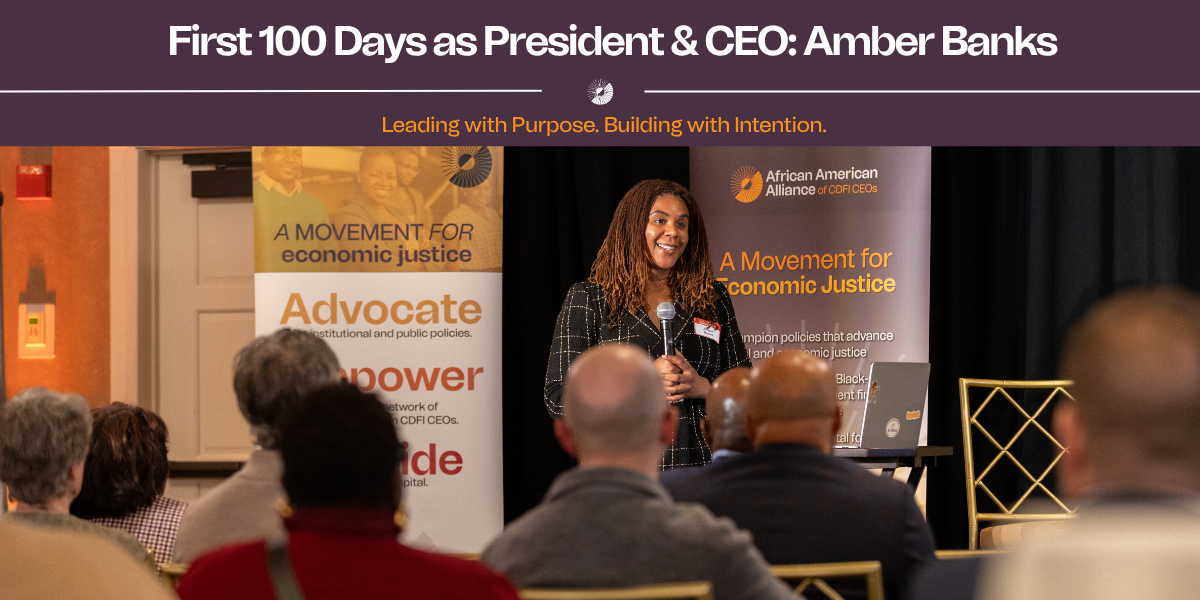
Orlando, Florida — January 6, 2026 — The African American Alliance of CDFI CEOs (“The Alliance”) proudly announces that Amber Banks has been appointed President & CEO, effective January 1, 2026. Banks succeeds Founder & CEO Lenwood V. Long, Sr., who is retiring after more than three decades of service in community finance and economic justice. 
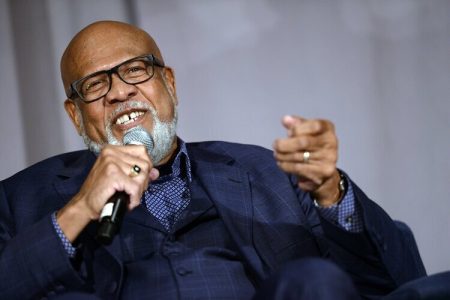
With more than two decades of experience at the intersection of economic development, social justice, and nonprofit leadership, Banks brings a bold vision for expanding access to capital, strengthening Black-led CDFIs, and elevating the Alliance’s voice on the national stage. 

“Amber’s appointment marks an exciting new chapter for the Alliance,” said Watchen Harris Bruce, President & CEO of Baltimore Community Lending and Chair of the Alliance Board of Directors. “Her deep expertise in racial and economic equity, her proven ability to build inclusive leadership, and her passion for community-driven solutions make her uniquely qualified to guide the Alliance into the future.” 

Banks has led initiatives that unlocked millions of dollars in lending for entrepreneurs of color, built national coalitions to channel philanthropic and federal resources into underserved communities, and mentored a new generation of diverse leaders in community finance. She has also been a cornerstone of the Alliance’s leadership team since its early years, serving first as Executive Vice President & Chief Operating Officer, where she strengthened operations, improved systems and processes, and aligned staffing and resources with strategic priorities. She was then promoted to President in 2024, where she spearheaded strategies to advance the organization’s mission, oversaw financial planning and resource allocation, cultivated national partnerships, and represented the Alliance as one of its lead spokespeople with media, policymakers, and stakeholders. 

“I am honored to carry forward the Alliance’s legacy, to strengthen our membership, and to confront the racial wealth gap as a united force,” said Amber Banks, President & CEO of the Alliance. “This is not just my leadership moment, it is our movement – and I can’t wait to roll up my sleeves, work with our members, and take our fight for equity to the next level.”  

Under her leadership, the Alliance will focus on: 

  • Expanding lending and capitalization for Black-led CDFIs. 
  • Elevating the voice of Black economic leaders in national policy and industry conversations. 
  • Strengthening member services with measurable benefits and expanded support. 

Founded in 2020 under the leadership of Lenwood V. Long, Sr., the Alliance has grown into a national membership organization representing more than 80 Black-led CDFIs and 40 mission-driven organizations. The Alliance has secured historic federal and philanthropic funding, launched groundbreaking initiatives such as the Equity Impact Scorecard, Black Renaissance Fund, and established itself as a leading voice for racial and economic justice. 

To learn more about The Alliance, visit www.aaacdfi.org.  

# # #  

About the African American Alliance of CDFI CEOs 

The African American Alliance of CDFI CEOs is a coalition of 129 Black-led community development financial institutions (CDFIs) and mission-driven organizations committed to closing the racial wealth gap and expanding economic opportunity in Black and historically excluded communities. Through advocacy, capacity-building, and partnership, the Alliance equips its members to grow their institutions and strengthen their impact. 

For more information, visit www.aaacdfi.org 

Media Contact 

Iyanna Peoples 
Associate, Marketing & Communications 
African American Alliance of CDFI CEOs 

[email protected], (910) 518-9201 

New RFP: African American Equity Impact Scorecard Capstone Report

The Alliance is seeking a qualified consultant to develop a Capstone Report that captures the evolution, impact, and legacy of the African American Equity Impact Scorecard initiative. Over the past four years, this initiative has empowered CDFIs to assess and enhance their effectiveness in serving Black communities. The final report will serve as a thought leadership piece, showcasing case studies from leading practitioners, highlighting key insights, and offering actionable recommendations for CDFIs, funders, and impact investors. It will also reflect how the Alliance has embedded Scorecard principles into its ongoing work, ensuring the initiative’s influence continues beyond its formal conclusion. For more details, see attached RFP.

Letter of Intent Due: October 17, 2025
Proposal Due: October 24, 2025
For questions or concerns related to the attached RFP, please contact: Laudz Jean-Jacques, [email protected], (910) 849-2963

Government Shutdown: What It Means for Communities

Congress did not pass a funding bill by the September 30 deadline, and parts of the federal government have shut down. Both parties outline different priorities, but the shutdown has immediate consequences for workers, contractors, and families across the country. 

Republican leaders say the government should reopen with a short-term funding bill that carries no policy add-ons. They say a stopgap should maintain operations while larger policy questions move through regular order with hearings, amendments, and separate votes. They say long-term spending or policy changes should not be set inside a deadline bill. 

Democratic leaders contend that certain health provisions cannot wait. They say the funding bill should keep the larger Affordable Care Act (ACA) premium tax credits in place beyond 2025 so families know what they will pay during open enrollment and should undo recent Medicaid changes they believe would raise costs or make coverage less stable for low-income households. 

While both sides frame their positions as protecting the public, the shutdown’s effects are already being felt. Federal employees face unpaid work or furloughs. Federal contractors – who clean offices, provide security, and serve meals – often never receive back pay. Families who depend on federal services face slower responses and longer waits. Even as some benefits continue by law, customer service and routine processing slow down when offices are short staffed. Households that already budget to the dollar have the least room to absorb this shock. 

Our request to national leaders is simple: do not lose sight of who bears the cost of a shutdown. Keep workers, contractors, and families at the center of every choice you make. Debate the policies, present the data, and hold the votes—but do not make those with the least cushion pay the price for the argument. 

Black-led CDFIs Gain Targeted Support through the CDFI Certification Readiness Accelerator 

In December 2023, the CDFI Fund introduced a new certification process, requiring all CDFIs to undergo recertification. The revision sparked urgency among certified Alliance members to safeguard their status to prevent disruptions in funding and resources, while members pursuing certification for the first time needed tailored guidance to navigate the new requirements. To bridge this gap, the African American Alliance of CDFI CEOs (The Alliance) launched the CDFI Certification Readiness Accelerator (CCRA) program—an intensive 16-week program designed to help Black-led financial organizations achieve CDFI certification. 

The program is structured into cohorts, each with seven member organizations that gain tools to navigate the revised certification process, identify organizational vulnerabilities, and take concrete steps toward submitting strong, competitive applications. In partnership with Friedman Associates, participants benefit from the guidance of an experienced CDFI consultant—addressing certification challenges while also laying the foundation for the CCRA to grow into a long-term, core offering of The Alliance. The goal is for members to remain well-positioned to access capital and continue driving impact in their communities for years to come. 

Since launching in Fall 2024, CCRA has seen two cohorts successfully complete the program. A few CDFI certified participants shared that they applied to the program in hopes of receiving clear, targeted guidance rather than facing duplicative steps that would do little to enhance their recertification process.  

With its direct relevance to the real-time demands of CDFI recertification, the CCRA was embraced by members as a practical solution to strengthen their readiness. 

We’ve been considering and working towards becoming more systematic,” said Jay Diallo, President & CEO of First Community Capital. “The training has guided us on the path of tightening and improving our processes, bringing us closer to aligning our documentation directly with CDFI Fund expectations. [Friedman Associates] provided technical depth, practical resources, and an understanding of the unique challenges Black-led CDFIs face.” 

The MyFund Workbook App played a central role, offering a secure, cloud-based platform that streamlines application preparation through guided data entry, compliance checks, collaboration features, and actionable insights to easily navigate AMIS (the CDFI certification online portal). Complementing this, Friedman Associates provided peer learning sessions, office hours, and one-on-one technical assistance support, along with tailored deliverables with action items to remediate before participants submit their application. They also shared key findings and recommendations with The Alliance to help shape future cohorts. 

“The CCRA program has prepared [Rende Progress Capital] to know the different questions and categories to be aware of in the CDFI Fund re-certification application,” said CQ Huynh, General Manager of Rende Progress Capital (RPC). “I am more educated and informed about the CDFI re-certification process because of this program. Also, my documentation, compliance, and internal processes have been improved, and I know what to do the next time.” 

Systemic inequities often leave Black-led financial institutions underfunded compared to their peers. Securing large-scale investments, philanthropic partnerships, and government resources can be disproportionately difficult, while limited staffing and back-office infrastructure make it challenging to meet growing compliance and reporting requirements. At the same time, these institutions are tasked with closing capital gaps in credit, lending, and wealth-building opportunities which are barriers they must also navigate as financial organizations operating within an unequal system. 

“Overall, CDFIs of color face the asset inequities that our White peers do not face according to the U.S. Treasury CDFI Fund Institutional Level Report,” said Eric K. Foster, Managing Director of RPC. That report details the smaller asset size and capitalization we face compared to White-led CDFIs whose total assets in aggregate account for 90 percent of all CDFI loan fund assets.  I believe that program offerings by The Alliance, like the CCRA program, can further equip us to address capital and programmatic inequities.” 

CDFI Certification is a vital gateway for community organizations to access capital, partnerships, and growth. For Black-led CDFIs, it is especially critical to sustaining efforts that advance economic justice, support small businesses, and build wealth. 

Lenwood V. Long, Sr., CEO of The Alliance stated, “Resourcing our Black-led CDFIs is essential. When we equip these institutions with targeted tools and support, they are better positioned to resource and serve our communities. This is the cycle of economic empowerment we are committed to sustaining.” 

Through the CCRA, The Alliance reaffirms its commitment to equipping Black-led CDFIs with the tools to secure certification and expand their role in advancing economic justice. 

Black Innovation Takes Center Stage at FSC First Pitch Competition 

FSC First Team Stands with Pitch Competition Winners

In every era of progress, there are leaders whose vision and resolve shape the future. Today, the call is clear: our economy needs champions who are passionate about creating pathways of opportunity for Black entrepreneurs.  

Dawn R. Medley, President & CEO of FSC First, is a leader who understands that unlocking capital, fostering innovation, and investing in Black-owned businesses is a movement toward justice, equity, and wealth. As a member of the African American Alliance of CDFI CEOs (The Alliance), FSC First supports small business owners with 12 distinct loan products—delivering innovative, inclusive financing solutions that empower entrepreneurs and create clear pathways to growth for underrepresented and underserved communities. 
Closing Gaps: “0 to 100” Accelerator Program 

Black entrepreneurs often lack access to strong financial documentation, operational tools, or a reliable internal team. FSC First created the “0 to 100” Accelerator Program to close those gaps, offering structure, accountability, and training that enables growth-stage entrepreneurs to scale successfully and sustainably. Since 2023, FSC First has partnered with M&T Bank to host the 8-week program’s English-language cohort, awarding $10,000 in prizes to three outstanding business owners and reflecting a shared commitment to providing local entrepreneurs with the capital, guidance, and connections they need to succeed. 

On June 18, 2025, a live pitch event and graduation celebration was hosted at 21st Century Expo in Hyattsville, MD—a venue owned by a former FSC First client and current participant. That full-circle moment captured the true spirit of the program: sparking business growth, reinvesting in the community, and creating lasting economic impact. 

Pathway to Participation in the Program 

Applicants, managed through M&T Bank, had to meet specific eligibility criteria: 

  • Business must be located in Prince George’s County 
  • Must be in good standing with the State of Maryland 
  • Must have been operating for at least two years 
  • Must have earned $100,000+ in annual revenue (new criteria for 2025) 

Spanning industries such as technology, arts and entertainment, childcare, and tourism, the diverse group of entrepreneurs showcased strong potential and demand but needed structure and support to scale their businesses to the next level. 

The five finalists that advanced to the final pitch competition had three minutes each to pitch and two minutes for the judges to conduct a Q&A session. The judging panel (a successful business owner, a FSC First business development associate, and M&T Bank senior executive) offered feedback and encouragement to help participants refine their ideas and communication, while evaluating each pitch on clarity, viability, community impact, and presentation quality. 

The 2025 “0 to 100” Small Business Accelerator Pitch Competition winners were: 

  • Tiyana Robinson, Beauty Mogul International, LLC$5,000 and an additional $1,000 grant to support marketing efforts and technology enhancements 
  • Dominyece Gregory, Tuft’n Up DC LLC$3,000 
  • Josei Harris, Halema Inc$2,000 

The winners stood out for their strategic vision, creativity, and readiness to scale while keeping community impact at the core of their work. One winner aims to further develop a new software feature, while another will revamp their website and strengthen marketing efforts.  

“The most valuable part of the program was having access to our mentors,” said Tiyana Robinson, Founder of Beauty Mogul International, LLC. Every single session, I walked away with something new. This isn’t my first business—I’ve already scaled a company to seven figures—but it is my first time building a software business. Even with my experience, I still learned so much through this program. The quality of education was excellent, and the intimate group setting allowed us to connect, ask questions, and get real answers when we needed them. If I had to sum up the program in one word, it would be access—and I deeply appreciate that.” 

Beyond financial prizes, participants received leadership coaching to strengthen mindset and strategic planning, a professional content day with FSC First’s team capturing business photos and videos for free, and exclusive loan incentives from Medley, making it easier for participants to access capital. 

Lasting Impact in Prince George’s County 

Extending its impact beyond the accelerator, FSC First equips entrepreneurs with capital, advisory services, and educational programming created to support small business growth. From 2022 and 2025, FSC First has supported 5,252 businesses, facilitated 259 technical assistance programs, and dedicated 391 hours of personalized coaching to help entrepreneurs grow and thrive. 

For entrepreneurs looking to grow their business, FSC First shares this inspirational message: Start where you are. Build your team. And don’t try to do it alone. There are a range of services individuals can stay engaged with to support their journey: 

  • Ongoing loan programs 
  • One-on-one business advising 
  • Workshops and technical assistance sessions 
  • New training opportunities announced via FSC First’s website and newsletter 

The accelerator program stands as a powerful example of The Alliance’s mission to build bridges to economic stability and expand Black wealth.  

Learn more on how FSC First is building a stronger, more inclusive small business ecosystem in Prince George’s County at fscfirst.com